
From the spice-scented backstreets of Deira to family-run food trucks and Palestinian bakeries in Abu Dhabi, Arva’s mission is simple: to tell the stories that rarely make the news, but that capture the true heart of this region.

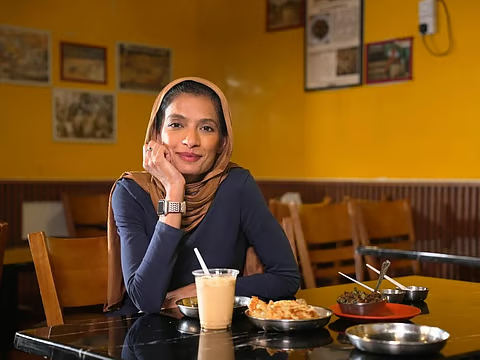
In a city often reduced to skyscrapers and superlatives, Arva Ahmed has carved out a different path. As co-founder of Frying Pan Adventures and host of Ditch the Silver—her weekly YouTube show and an upcoming 10-part docu-series for OSN—she has spent more than a decade guiding people through the humble, flavour-packed corners of the UAE. From the spice-scented backstreets of Deira to family-run food trucks and Palestinian bakeries in Abu Dhabi, Arva’s mission is simple: to tell the stories that rarely make the brochures, but that capture the true heart of this region.
In our constant endeavor to feature unique stories and people, we catch up with Arwa for a quick few questions giving us an insight into what makers her tick.
Q1. Origins and Vision
You’ve been running Frying Pan Adventures for over a decade. What gap in Dubai’s food and cultural storytelling did you see that pushed you to create something so different from the usual tour company?


Arva:
When I started Frying Pan Adventures, the spotlight in Dubai was firmly on the glitzy, high-end restaurants. They had the budgets, so they dominated the conversation. But that wasn’t the Dubai I grew up in. I wanted people to experience the simple, humble, nostalgic side of the city—the neighbourhoods where I still live and eat, where food feels raw, primal, and deeply human.
I’m a roll-up-your-sleeves, dig-in kind of person, and I felt there was a huge gap in how Dubai was being narrated. The story wasn’t inclusive. It was being driven by Western trends, instead of reflecting the many cultures of the East that actually thrive here. I wanted to bring depth into the storytelling, to shine a light on the people behind the scenes—the cooks, the families, the small vendors—because that’s where the real flavour of the city lies.

Q2. Storytelling Through Food Tours
Frying Pan Adventures has become synonymous with uncovering hidden neighbourhoods and unsung eateries. Beyond just food, your tours feel like cultural storytelling. How did that approach evolve, and what do you think makes travellers connect so deeply with it?
Arva:
When Frying Pan Adventures began, it wasn’t built around storytelling. It was simply my love for food and discovery. But getting the licence took a year, and in that waiting period I buried myself in food history, culture, and the work of writers who had travelled the world through food. That’s when it clicked—if I wanted these tours to mean something, they had to be more than just pointing out restaurants. Anyone could walk in and order a meal on their own. What I needed to give people was context.
Food isn’t just food. It’s a conversation about history, migration, tradition, etymology, even politics. For example, one of the books I came across was Day of Honey by Anya Ciezadlo, an American reporter who travelled through Lebanon and Iraq. When we eat Iraqi masgouf—a traditional barbecued fish—with our guests, we weave in her stories: the streets where it’s served, the nostalgia Iraqis attach to it, and her observation that Iraqis call it “the flavour of freedom.” That kind of context transforms a meal into something unforgettable.
Over time, as more storytellers joined our small team, each brought their own lens, and the stories matured. I think that’s why travellers connect so deeply. A compelling story brings food alive. It becomes more than what’s on the plate—it becomes a memory they carry long after.
Q3. From Tours to the Screen
You started with walking tours, and now you’ve taken that same spirit into YouTube and onto OSN with Ditch the Silver. How come your journey has taken this other turn into content and the screen? What pushed you to make that leap?
Arva:
My storytelling has evolved in stages. It started with a food blog through writing and photography. Then came the food tours, where stories became lived experiences. After that, my sister and I created a podcast called Deep Fried, which ran for three seasons. That was one of the hardest mediums because you had to make people hungry and engaged without visuals, only through sound.

I think of each medium as a set of paints and brushes. A blog gives you one palette. Tours give you another. A podcast strips away visuals and forces you to paint only with sound. With Ditch the Silver on YouTube and OSN, the entire box is open. I’m working in full colour. You have visuals, movement, and audio. The only thing missing is the food right in front of you.
The YouTube show has become a weekly drop, which keeps me in constant practice. Then there’s the 10-part docu-series we’re producing for OSN, set to release between the end of 2025 and the beginning of 2026. That has pushed me to scale my storytelling into something more ambitious.
The shift to video feels natural because the world is moving that way, but also because I am craving a bigger impact. Tours reach a handful of people at a time. I want to change how the world sees Dubai. I want people to realise it is more than glitz and glamour, that it is a food destination with depth. Each step feels ambitious, but it moves me closer. For me, it is not about choosing between tours, podcasts, or video. It is about using every brush in the box to spark a much larger conversation.
I also found the right partner with Ti22 Films, an award-winning company I’ve known for over a decade. They helped me take what was once a dream—a food show—and make it a reality.
Q4. The Real Dubai
Tourists are bombarded with glittery, curated experiences of Dubai. What’s a side of the city that rarely gets shown but that you’re determined to put front and centre in your tours and in the show?
Arva:
With both our tours and Ditch the Silver, the goal is to showcase corners of the city that rarely get the limelight. On the tours, that usually means the older side of town—Deira, Bur Dubai, Karama, Satwa. These neighbourhoods are walking-friendly and full of stories, and they’re the ones I grew up around, especially in the Rigga area.
But I also want to show that discovery isn’t limited to “old Dubai.” In the OSN series we were deliberate about being more inclusive, covering pockets across the city—Jumeirah, Khawaneej, even Motor City—because you can stumble on humble, character-filled spots almost anywhere. They may not be glamorous or designed to make Instagram feeds pop, but they are authentic. And that’s what I feel deserves the spotlight.
Q5. Stories that Stick
Out of all the humble eateries and neighbourhoods you’ve explored, can you share one story of a place or a person that left a lasting impact on you—and why it deserves the spotlight more than the five-star establishments?
Arva:
One of the moments that stays with me comes from filming Ditch the Silver for OSN. We were out shooting in the heat, exhausted from a long day, when we pulled up to a family-run food truck tucked away on private property. Unless you were a local, you’d never know it was there.
The mother had learned how to make mishkak—Omani-style barbecued skewers—and shuwa, slow-cooked lamb, from her own mother. So the recipes had been passed down through generations. The whole family was involved in running the truck. When we arrived, they welcomed us like old friends, served us with such generosity, and shared their story.
It was simple, humble, and incredibly moving. These are the stories we want to capture. They show the side of the region that rarely makes it to the spotlight—family traditions, recipes handed down, and the warmth of hospitality that stays with you far longer than the food itself.

Q6. Behind the Lens
Turning what you do on the streets into a series for OSN is a huge leap. What was the toughest challenge in translating your raw, street-level storytelling into something for television without losing authenticity?
Arva:
It is a huge leap, especially in a world where Instagram and TikTok have trained people to consume video in quick dopamine hits. The danger is falling into that same short-form drip feed instead of telling stories with depth. For me, the hardest part hasn’t been capturing the stories. It has been figuring out how to convey them on screen in a way that feels authentic and true to my voice.
That has meant rethinking everything, from scripting to how we plan shots to how the story eventually comes together in the edit. It has been a process of discovery, not just for me but for the team I work with. The right collaborators make all the difference. Working with Ti22 Films has been a game changer. They’re an award-winning production house I’ve known for over a decade, with experience spanning DXB Today on Dubai One and Studio Expo during Expo 2020. They know how to translate raw, street-level storytelling into a visual language that still feels natural.
At the end of the day, I can’t take all the credit. Ti22 helped me shape my approach, and together we found that balance between polished production and authenticity. Without that, the series wouldn’t have felt like me.
Q7. Beyond Dubai – Abu Dhabi’s Food Story
You’ve recently started curating food tours in Abu Dhabi. Can you share a stop or a story from there that, for you, captures the spirit of what Abu Dhabi brings to the table?
Arva:
When we branched into Abu Dhabi, one of the most meaningful experiences came in 2024, when we designed a food tour for Public Art Abu Dhabi in Madinat Zayed. The very first stop was Al-Khabbaz, a Palestinian bakery.
They bake their own kaak al-Quds, the traditional bread of Jerusalem, and fill it with smoked eggs, zaatar, cream cheese, shatta, and plenty of olive oil. It’s a sandwich I first encountered in Jordan, and to see it recreated here was extraordinary. The bakery itself is deeply sensory, from the smell of bread baking to the trays of cookies that they hand out generously while you wait in line.
What makes it powerful is the reminder of heritage. In the times we’re living through, it felt important and humbling to showcase Palestinian culture in this way. And the joy for our guests was discovering something they may never have realised existed—a layered sandwich with flavours and a story that reach far beyond the plate.

Q8. Your Personal Why
You’ve spoken about growing up here, about the streets and flavours shaping you. What keeps you personally invested in telling these stories day after day, even when it would be easier to scale back or sell out?
Arva:
I wish I had a more profound answer, but this feels like my calling. It’s what gets me excited to get up and do things. What keeps it fresh is branching out into different forms of storytelling. If I was doing the same thing a hundred percent of the time, I’d be bored. I like to constantly learn, and with every new format or every new food culture, I realise how much I don’t know.
East African food culture, for example, is something I’ve only just begun to scratch the surface of. Chinese food has been on my list for years. The more I learn, the more I discover how much more there is to learn. That sense of discovery is huge for me.
The other piece is impact. On a tour, I can see people walking away having experienced something they might never have discovered on their own. Online, when the community writes in after a video and tells me they’ve been inspired to try a place or see Dubai differently, that’s when I feel it. That sense of impact is what keeps me personally invested.
For Arva, food is never just about eating. It’s about heritage, discovery, and the impact of sharing those stories with others. Whether she’s leading a walking tour through old Dubai, filming with Ti22 in the backstreets of Karama, or unearthing a Palestinian bakery in Madinat Zayed, the mission is the same: to keep learning, to keep uncovering, and to help others see the UAE through a more authentic lens.
Discover more from Experience Abu Dhabi
Subscribe to get the latest posts sent to your email.


